Queens CofE Academy Love in Action
Our History
Queen’s CE Junior School in Nuneaton came into being as a result of the need for new schools after the Balfour Act of 1902 enabled working-class children to be given full-time education & with the school leaving age rising to 14 by 1914.
It was the first time bright children had the chance to fulfil themselves, but of course, in those days few families could afford to let their children stay on at school once they had reached 14.
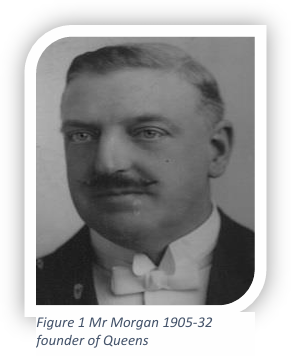 In 1903 a temporary Queen’s school was opened by Mr Morgan (pictured left), and his 3 sisters. By 1905, the temporary school now boasted 380 pupils.
On July 3rd 1905, Queen’s Road School was formally opened by Mr E Gray, MP, and the number of children enrolled was 680, which grew to 960 pupils in just one year.
In 1908, an infant school building was opened, and the total numbers now reached 1,300.
War was to interrupt the way of life for many people of all ages in 1914, and the following year three members of staff had enlisted in the armed forces.
One of these was Charles Streather (pictured right), who would go on to serve with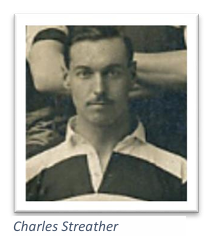 distinction as a Sergeant with Nuneaton’s own 216 Regiment and who, after war service, returned to his profession, eventually becoming the first headmaster of Higham Lane Secondary school in Nuneaton.
distinction as a Sergeant with Nuneaton’s own 216 Regiment and who, after war service, returned to his profession, eventually becoming the first headmaster of Higham Lane Secondary school in Nuneaton.Mr Morgan continued with unabated vigour until the end of 1931, but during the Christmas holidays he was taken ill and died a few days after the school re-opened.
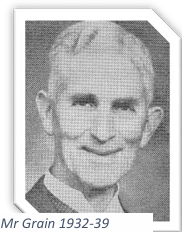
In May 1931, Mr Grain (pictured left), was appointed to succeed Mr Morgan and Mr Streather became deputy head.
As the school grew with the country’s continuing educational developments, it was decided that at Easter 1939, Queens Road School should become a junior and infant school.
Although Nuneaton suffered some bombing during World War 2, notably the virtual destruction of Coton Church and other private dwellings, the school escaped serious injury during the big air raid of May 1941.
The school was used as a rest centre for a couple of weeks during this period, as well as accommodating pupils from the Coton Council School whose own premises were badly damaged.
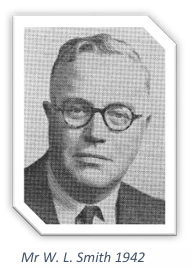
The last of the Morgan family retired in 1941 after three decades of loyal service and Mr W L Smith (pictured right), was appointed the new head teacher on January 1st 1942.
A new head mistress was to take charge of the infant department when Mrs King retired and Miss Fazackerley took over her role in 1951.
The Silver Jubilee was recorded in 1955 when Queen’s basked in the knowledge that for 50 years they had continually provided a superb education. And at this stage several family members had gone through its ranks as pupils.
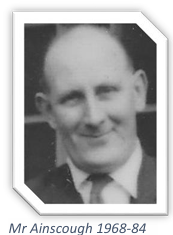 Another man who would notch up an incredible number of years’ service to Queens was appointed in 1968, when Mr Harry Ainscough took charge as the new head teacher. It was during his stewardship that, in 1972, the last Queen’s children sat the dreaded 11+ exam. During this reorganisation of education, the school was renamed Queen’s Church of England Middle School with an opening roll of 738.
The last use of the cane was also administered for the final time in 1984 and five years later, Mr Ian Wilman took over as new head. He was succeeded in 1997 by Suzanne O’Connell and then in 2008, Manjit Kaur took charge until 2013.
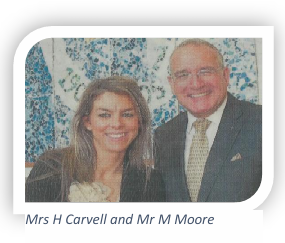
In 2013, Mitch Moore was appointed executive head teacher of both St Laurence’s and Queens. Mrs Hannah Carvell joined him as head of school in 2014, embarking on a new chapter as Queen’s C of E School became the Queens Church of England Academy we know today!